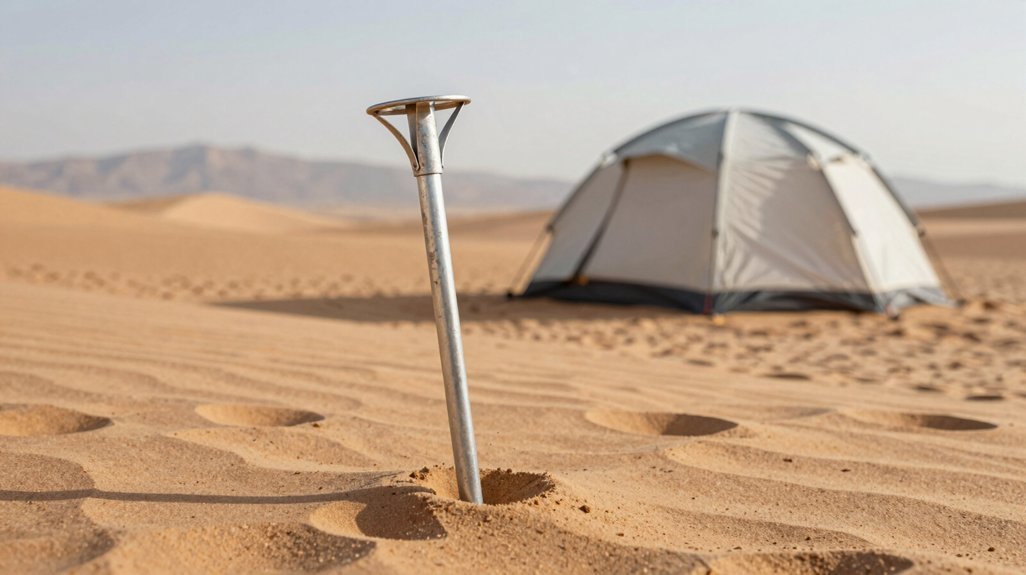
You probably don’t realize that sand can exert over 300 pounds of pull on a tent stake during a sudden gust, which is why your standard shepherd’s hook bends like a paperclip the moment the wind picks up. I’ve watched plenty of campers chase their gear down the beach because they trusted the wrong anchor for the job.
The fix isn’t complicated, but it is specific: you need to match your method to the sand’s density, moisture, and your expected wind load. Here’s what actually works.
Why Regular Stakes Fail in Sand
Why do your tent stakes keep slipping free the moment a breeze picks up at the beach? You’re watching your shelter flap wildly because regular stakes weren’t built for this.
Standard stakes rely on narrow profiles designed for dense, compact soils. In sand, you’re fighting physics you can’t see. Dry, loose sand has low shear strength, meaning it shifts and can even liquefy under sudden load. Your stakes simply don’t engage enough surrounding material to create friction.
The math works against you. A typical 6-inch stake presents minimal surface area. Sand particles flow around it rather than gripping. You’re essentially pinning a tent to a liquid.
Without depth and width to distribute force, your hold disappears instantly. The wind doesn’t need much leverage. You’ve probably learned this the hard way, cursing while chasing gear down the shoreline.
Recommended Products

Quality: Our 5-inch 11 gauge Garden stakes are made of high-strength galvanized steel and are hard and strong. Specially designed silver white Garden Stakes are available for outdoor decoration and landscape garden decoration.

Size and packing: Snow tent stakes is 9.06" x 1.42" tent stakes, including 4 Pcs ground nails
Match Your Sand Type to the Right Anchor
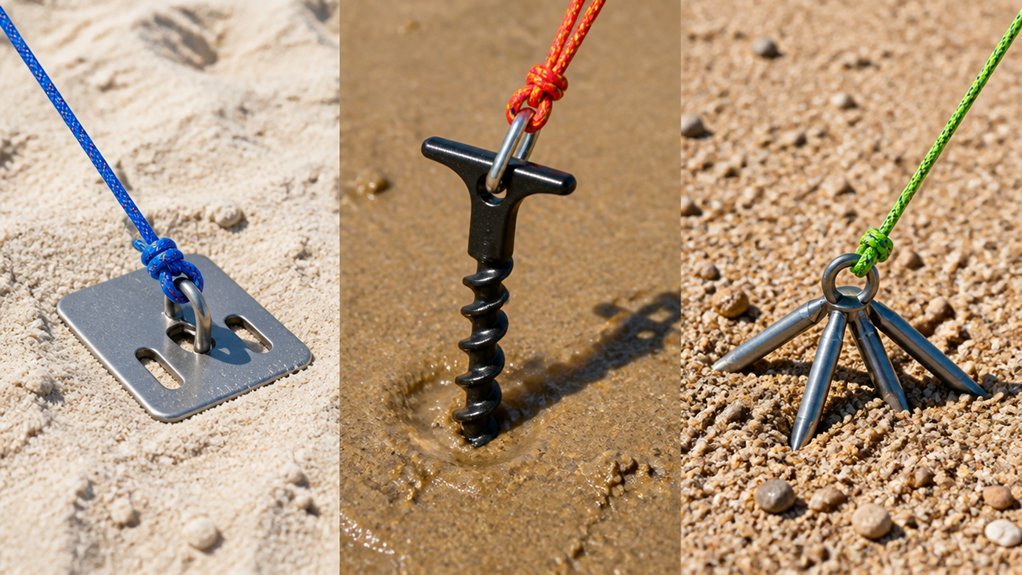
You’ll need different anchors for loose dry sand versus compact wet sand, even though both look similar at first glance. In loose dry conditions, you’ll want screw-in stakes or broad-bladed designs that maximize surface area, since the particles shift and need something to grab onto.
Compact wet sand actually holds surprisingly well, so you can get away with longer titanium nails or Eastons driven at that 45-degree angle away from your tent, though you’ll still want to loosen the top layer first.
Recommended Products

Ultra Light: Our 7075 aluminum tent stakes, weighing only 14g (0.5 oz) per stake, ultra-light yet sturdy, securely anchor your tent while camping, ultralight backpacking and thru-hiking; While flexible and break-resistant, these camping essentials can be straightened and reused after bending; Experience heavy-duty holding power without the back-breaking bulk
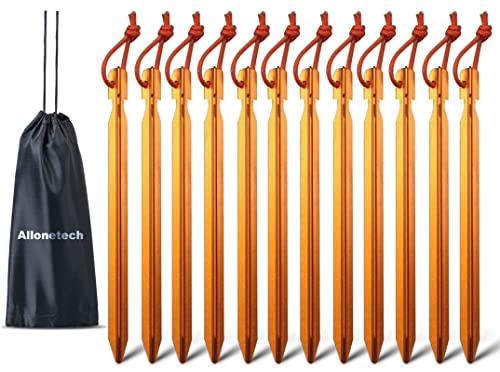
Ultra Light: Our 7075 aluminum tent stakes, weighing only 14g (0.5 oz) per stake, ultra-light yet sturdy, securely anchor your tent while camping, ultralight backpacking and thru-hiking; While flexible and break-resistant, these camping essentials can be straightened and reused after bending; Experience heavy-duty holding power without the back-breaking bulk

PREMIUM MATERIAL - Constructed from ultra-strong titanium alloy. These V-shaped titanium stakes can penetrate and hold firmly in a wide range of soil conditions.
Loose Dry Sand
How do you keep a tent from flying away when the sand beneath your feet shifts like sugar? You reach for sand anchors that bite deep and wide.
Skip those skinny nail stakes. They’ll pull free before you’ve unzipped your rainfly. Instead, grab U-shaped or V-shaped stakes. Their broad blades displace more sand and resist pull-out far better than narrow designs.
For truly powdery conditions, bury a fabric deadman anchor parachute-style. It engages a massive sand mass above the stake, multiplying your holding power dramatically.
If the sand’s moderately compact, auger anchors screw down deep for serious resistance. I’ve watched standard stakes fail in minutes on dunes. These alternatives? They hold through gusts that’d send your neighbor’s tent cartwheeling.
Compact Wet Sand
Where do you turn when the sand packs firm and glistens with moisture? Compact wet sand offers better natural grip than its dry cousin, but you still need stakes with serious holding power to keep your shelter secure.
Here’s what works:
- Choose longer, thicker stakes; eight inches minimum gives you real purchase in dense sand
- Grab U-shaped or flat-bladed designs; their broad surfaces fight pullout forces effectively
- Try screw-style auger anchors when compaction is moderate; the deeper you twist, the better they bite
- Pick aluminum or titanium, though I’ve watched V-stakes deform under strain; handle them gently
When the tide’s coming in or rain soaks your site, that extra holding power matters. Get your stakes deep, angle them away from the tent, and you’ll sleep soundly.
Drive Screw-In Sand Stakes at 45 Degrees
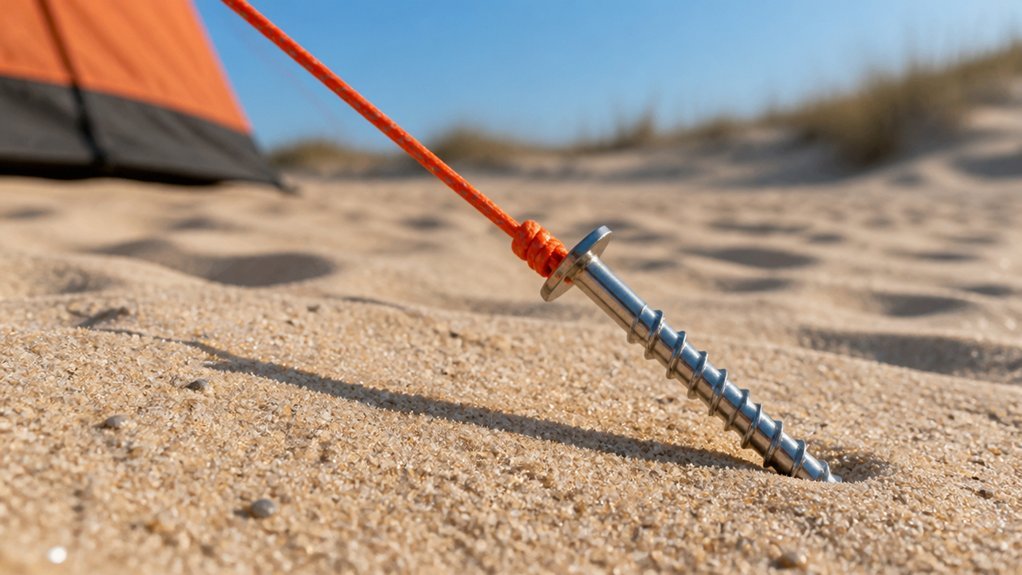
You’ll get the most holding power from screw-in sand stakes by driving them at a 45-degree angle away from your tent, which distributes the load along the entire stake length rather than concentrating stress at a single point. This optimal driving angle works particularly well in moderately compact sand where the screw threads can bite deeply.
I’ve found it still holds surprisingly well in loose, dry conditions where vertical stakes would pull straight out. When it’s time to pack up, you’ll want to unscrew counter-clockwise to minimize sand disruption and make removal effortless.
Recommended Products


Choose American, Choose Certainty. Eurmax Canopy is North America’s #1 factory store, stocking all canopies, Trampoline accessories, All Kinds of Ground Stakes Right Here in the U.S.

18 Inch GROUND ANCHOR HEAVY DUTY - the auger shape of spiral stakes provide penetration into the soil and better grip with less screwing effort due to the two types of augers, with different sizes on the spiral part: 30 mm width and 68 mm width
Optimal Driving Angle
Why does your tent still drift sideways in a midnight gust when you’ve buried every stake deep? You’ve driven your stakes straight down, haven’t you? That’s the problem. In sand, vertical stakes pop out like corks. You need to drive screw-in sand stakes at a 45-degree angle, leaning away from your tent. This positioning changes everything.
Here’s what that angle accomplishes:
- Distributes tension across a broader surface area, so your guylines pull effectively
- Prevents straight upward extraction forces from defeating your anchor
- Aligns with how sand actually grips, not how you’d wish it would
- Creates balanced resistance when wind hits multiple corners simultaneously
Keep every stake at that consistent 45-degree angle. Your shelter stays put. Simple physics, finally working for you instead of against you.
Counter-Clockwise Removal
Once you’ve got those screw-in stakes buried at 45 degrees, you’ll face a different challenge: getting them back out without a fight. Here’s where counter-clockwise removal saves your sanity. You’ll grip the stake head firmly and rotate it left, letting the threads guide it upward through the sand. The same helical design that locked your tent down now works in reverse, breaking the compacted grip without brute force.
This technique shines in medium-density sand where traditional straight stakes bind up or bend. I’ve watched friends wrestle with bent metal for ten minutes while I unscrewed mine in thirty seconds. The 45-degree angle you drove them at, combined with proper counter-clockwise removal, minimizes resistance and preserves your gear.
For sand anchoring that lasts trip after trip, screw-in stakes deliver. You’ll reinstall them easily at the next site, no replacement needed.
Pick U-Shaped Stakes for Soft, Shifting Beaches
How do you keep a tent from becoming a kite when the beach sand starts shifting beneath your feet? You grab U-shaped stakes. Their broad profile gives you the surface area you need where holding power depends on wide contact with loose substrate.
Unlike narrow-nosed designs, these sand anchors displace more material and grip better under wind load. They’re lightweight, typically aluminum or engineered plastic, so you’re not hauling extra weight to the beach.
Drive at 45 degrees away from your tent. Bury deep enough to optimize anchoring. Pair with properly tensioned guylines. Check compatibility with your existing setup.
Angle and depth matter. Get both right, and you’ve got reliable resistance against lateral and upward forces. Skip the technique, and even the best stake fails.
Recommended Products

𝐁𝐀𝐂𝐊𝐏𝐀𝐂𝐊𝐈𝐍𝐆 𝐄𝐒𝐒𝐄𝐍𝐓𝐈𝐀𝐋 – The Vargo Titanium Nail Peg is exceptionally strong and provides excellent holding. Its flat head and straight shaft won’t bend when pounded into even the hardest soil.

☀Specifications: 7*200MM/38g, 8*240MM/56g, 8*300MM/71g, 8*350MM/81g, 8*400MM/96g.

☀Specifications: 7*200MM/38g, 8*240MM/56g, 8*300MM/71g, 8*350MM/81g, 8*400MM/96g.
Bury Deadman Anchors for Maximum Hold
When the wind picks up and your U-stakes start to wobble, you’ll want something that won’t budge. That’s when you’ll bury deadman anchors horizontally for maximum holding power.
Dig down 30–40 cm (about 12–16 inches) in loose sand. You’ll use a fabric panel or parachute-like sheet, wrap your guyline around it, and backfill to create broad resistance. The wider your buried surface, the better it fights upward pull compared to standard sand stakes.
Compact the covering sand by walking on it for stability. You’ll add a rock or stake on top for extra security against guylines pulling upward.
When it’s time to pack up, you’ll loosen surrounding sand first, then unearth your deadman rather than yanking straight up. This preserves your gear and saves frustration.
Recommended Products

RECOVER YOURSELF WITHOUT A SECOND VEHICLE — The Deadman V2 creates a winch anchor point anywhere: bury it in sand, mud, or snow as a ground anchor, wrap it around a tree as a tree saver strap, or sling it around a boulder as a rock anchor. One piece of gear replaces three.

2-IN-1 JET SKI SAND ANCHOR & DRY BAG: Designed as a portable sand anchor for jet skis, PWCs, kayaks, paddle boards, small boats, floating mats, and similar personal watercraft. Also functions as a waterproof dry bag for clothing, towels, phones, and other essentials when not used as an anchor

Heavy Duty: The bag made from marine-grade 500D PVC material, equipped with the high density PE anchor rope, this PWC anchor will be very durable and not fade, with resistance to sun expose and salt water
Anchor With Rocks When Stakes Won’t Penetrate
Deadman anchors work great in loose sand, but you’ll hit a wall when the ground itself fights back. When rocky soil blocks your stakes, you’ll need to improvise with rock anchors instead of fighting futilely. I’ve watched tent stakes bend against buried limestone, so here’s what actually works:
Dig a shallow hole and wedge a heavy rock over your guyline to create downward pressure. Stack multiple stones around a buried stake to increase lateral resistance when rocks prevent deep penetration. Extend your deadman anchoring technique by using a boulder as the anchor mass
Recommended Products
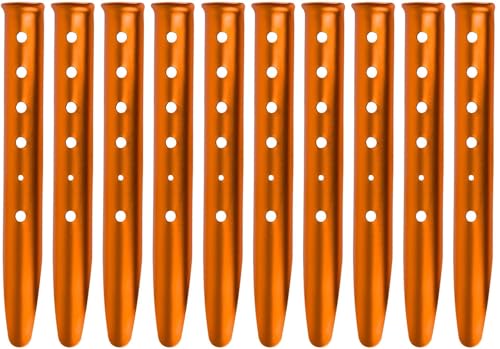
What Yoy Get: Package includes 10pcs of tent stakes. Size of each stake: Length - 12.2 inch / 31cm. Width - 1.42 inch / 3.6cm. Weight: 1.84 oz / 52g
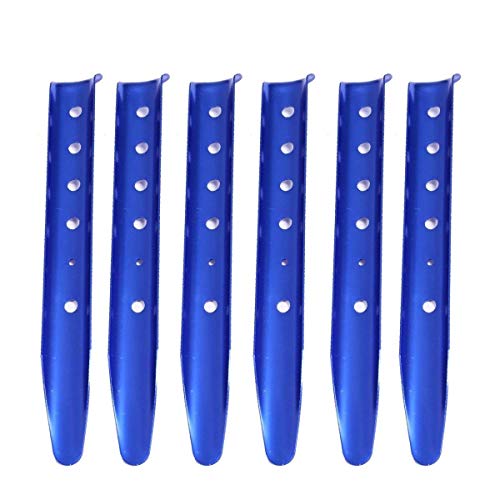
✅ Quality Heavy Duty Tent Stakes: Made from high-strength aluminum, these large camping stakes are lightweight, durable, and built to last, providing reliable performance in soft ground like sand and snow
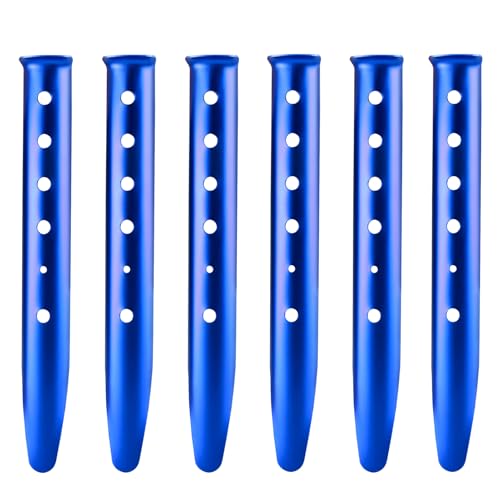
Specifications: Material - High strength aluminum; Length - 12.2 inch / 31cm; Width - 1.42 inch / 3.6cm; Weight - 1.84 oz / 52g
Use Sandbags for Quick, No-Dig Setup
Why dig at all when you can let the sand do the work for you? Sandbags turn loose beach sand into instant anchors without breaking a sweat. You’ll fill fabric bags with local sand, then bury them over your guylines or around the tent perimeter. This no-dig approach adds serious weight and friction where stakes fail.
Proper anchoring means securing guylines directly to the bags and pressing them flush against the ground. Any gap kills your wind resistance. I’ve watched tents lift off because someone got lazy with placement.
When gusts hit hard or the sand’s too soft for stakes, sandbags save your setup. They’re modular, rapid to deploy, and play nice with other methods. For temporary beach shelters, you won’t find a faster stabilization option.
Recommended Products

Material: Titanium Alloy

Value Pack: You will get 20 Packs of heavy-duty tent stakes; 9.75 inches in length. Diameter: 7 mm

Material: Titanium Alloy
Sink Tent Legs in PVC Tube Anchors
You’ll want to start by selecting PVC tubes wide enough to fully encase your tent legs, typically 2 to 3 inches in diameter, which prevents wobbling and distributes the load across loose sand. Bury each tube 1 to 2 feet deep, packing sand firmly around the exterior, and angle your guylines at 45 degrees away from the tent for maximum holding power.
I’ve watched these anchors outperform standard stakes in coastal winds, and sealing the tops with sand or rigid caps keeps everything locked in place when gusts hit.
Recommended Products


30 Inch GROUND ANCHORS HEAVY DUTY - the auger shape of spiral stakes provide penetration into the soil and better grip with less screwing effort due to the two types of augers, with different sizes on the spiral part: 30 mm width and 68 mm width

PVC Tube Selection
How do you keep a tent from wobbling when the sand beneath it keeps shifting? You grab PVC tubing and create a rigid anchor system that resists tipping by distributing load away from the stake point. Sleeve stabilization starts with selecting the right diameter: 1.5 to 2 inches fits standard aluminum or steel legs snugly. Too loose and the leg rattles; too tight and you’re fighting friction.
Here’s what you need to nail this:
- Measure your tent legs before buying, accounting for any foot caps
- Choose schedule 40 PVC for rigidity without excessive weight
- Cut tubes 24 to 30 inches long to achieve proper buried depth once installed
- Smooth all cut edges so you don’t shred your gear or hands
Taper the buried end and fill with compacted sand for mass. You’ll stop lateral drift cold.
Burial Depth Technique
Drive the PVC tube into sand that’s been pre-dug to the right depth, and you’ve built something that actually fights back when the wind picks up. Your burial depth matters here; aim for at least 18 inches in loose dunes, less in packed beach sand.
You slip the tent leg through the PVC tube before burial, creating a buried deadman that transfers vertical load straight down. The tube sits flush with the surface, leg angled toward your tent.
Backfill firmly, pack it tight. Friction does the heavy lifting in sand anchoring, and sloppy backfill wastes your effort. I’ve watched half-buried tubes creep loose overnight, frustrating when you’re chasing sleep.
Dig out carefully when breaking camp, pull upward slow. Your stake system survives another trip, and you’ll actually reuse this setup.
Guyline Attachment Method
Once you’ve got that PVC tube buried and packed tight, the real magic happens when you connect your guylines. You’re creating a buried anchor that distributes tension across the sand, not just at a single point. I’ve watched too many tents pancake because someone skipped this step.
Here’s how you lock it in:
- Bury your PVC tubes 6–12 inches deep, angled 45 degrees away from the tent for ideal pull resistance
- Backfill and pack sand hard around the tube; loose fill equals loose tent
- Tie your guyline to the exposed end using a taut-line hitch so you can adjust tension without retying
- Walk the perimeter and tension evenly; uneven stress pops buried anchors every time
Get this right, and you’ll sleep through gusts that send other campers scrambling.
Tension Guylines for Wind-Resistant Stability
Why do some tents collapse in a stiff breeze while others barely flutter? The secret lies in how you tension your guylines for wind resistance and sand anchoring.
You drive your tent stakes at 45 degrees, pointing away from the tent to maximize outward pull. This angle directs wind load into the sand mass rather than against it. You want even tension across all guylines, because uneven stress creates single points of failure that’ll loosen your whole setup.
For sand anchoring, pair longer aluminum or titanium stakes with broad, surface-area-rich designs like U-shaped or V-shaped blades. These increase friction where smooth stakes fail.
In extreme wind, bury fabric deadman anchors horizontally and backfill them, distributing load across a large sand mass rather than depending on narrow points.
Recommended Products

☀Specifications: 10 * 160MM / 13G, with lanyard, easy to fix on the tent, easy to pull out.

Upgraded Heavy Duty Camping Stakes: Made of high-quality forged S45C steel, completely get rid of the snapping and bending, more durability, they are corrosion resistance

✅ Premium Rust-Resistant Metal: Crafted from high-strength, anti-rust metal, AVOFOREST tent stakes are built to withstand harsh outdoor conditions. Unlike flimsy plastic or low-quality iron pegs, these heavy-duty stakes offer superior durability and bending resistance, ensuring your shelter stays secure season after season.
Remove Sand Stakes Without Snapping
You’ve spent hours perfecting your guyline tension and burying deadman anchors for that bomber setup, but now the wind’s dying and it’s time to pack out. Don’t wreck your gear in the final moments. Your removal technique determines whether these sand stakes survive another trip.
Loosen the sand around each stake, then wiggle and rotate while pulling to break suction and preserve stake integrity.
Unscrew screw-in models counter-clockwise; leverage U-shaped stakes with a second stake to avoid bending.
Dig out deadman anchors horizontally, removing the buried bag or fabric before lifting, never pulling straight up.
Backfill and compact holes in loose sand after extraction to prevent collapse during re-staking.
Match your method to the stake type. You’ll minimize force and maximize reuse potential. I’ve snapped enough aluminum stakes to learn this the hard way. Treat them right, and they’ll hold for seasons.
Recommended Products

【High-Strength & Rust-Resistant】Crafted from top-grade 304 stainless steel, our boat anchor is engineered for both saltwater and freshwater. Its robust construction ensures lasting strength and resistance to corrosion—keeping your boat secure season after season.

Triple Duty PWC Gear: Constructed with heavy duty PVC material, fill this handy bag with sand and anchor your jet ski and paddle board! Or, leave it empty and fold the roll top to use as a buoy or use it as a dry bag for your personal items!

MULTI PURPOSE:The anchor bag constructed with heavy duty PVC material, fill this handy bag with sand and anchor your jet ski and paddle board! Or, leave it empty and fold the roll top to use as a buoy or use it as a dry bag for your personal items!